You’ve been here before. The PowerPoint slides were perfect. The executive team nodded approvingly at your comprehensive AI strategy. Maybe you even got budget approval and a pat on the back for “forward-thinking leadership.”
Six months later, you’re still explaining why that chatbot pilot hasn’t made it to production.
You’re not alone in this frustration. According to RAND Corporation’s 2024 enterprise AI study, nearly 60% of AI projects in large organizations fail to deploy beyond proof-of-concept stage. Gartner projects that through 2027, most enterprise AI initiatives will remain trapped in what they call “pilot purgatory.”
The problem isn’t your technical team. It’s not even your data (well, not entirely). The issue is that most AI roadmaps are built forward from ambition instead of backward from shipping constraints.
Why most enterprise AI roadmaps never leave the slide deck
Let’s start with an uncomfortable truth: failure is the norm, not the exception.
The data tells a brutal story. Beyond RAND’s findings, McKinsey’s 2024 State of AI report found that only 22% of enterprises using AI have achieved meaningful business impact from their investments. The majority are stuck cycling through proof-of-concepts that demonstrate technical feasibility but never touch actual business workflows.
Four failure modes dominate these statistics. First, misaligned executive expectations where leadership expects ChatGPT-level magic from narrow business applications. Second, production-hostile data that works fine for demos but crumbles under the quality, governance, and latency requirements of real applications. Third, absent MLOps capabilities that leave data scientists manually babysitting models that should be running autonomously. Fourth, the “innovation theater” problem where pilots exist to demonstrate activity rather than deliver measurable value.
The structural tension runs deeper than knowledge gaps. AI initiatives require 12-18 month time horizons to show meaningful business impact, but enterprise budget cycles and leadership attention spans operate on quarters. You’re not managing a technical challenge, you’re navigating organizational physics.
What an AI roadmap actually is (and what it isn’t)
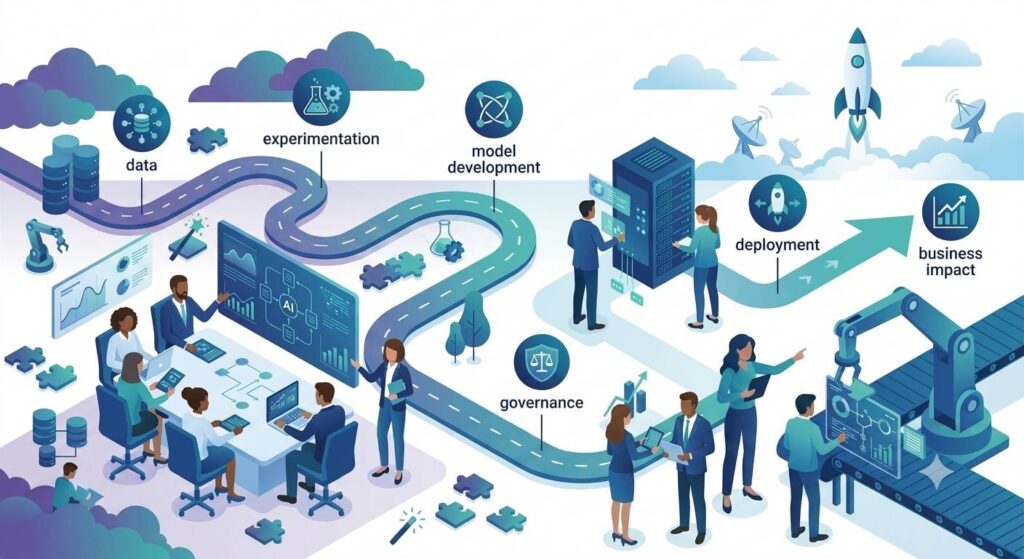
An AI roadmap is a phased plan for evaluating, building, deploying, and scaling AI capabilities within an organization, accounting for data readiness, infrastructure constraints, governance requirements, and organizational alignment timelines.
Notice what’s missing from that definition: technology wishlists, vendor implementation schedules, data science team backlogs, or individual career development plans.
The search results for “AI roadmap” reflect this confusion. Most top results are individual learning paths for aspiring engineers, not organizational strategy documents. Reddit discussions focus on technical skill acquisition. Even comprehensive GitHub guides address personal development rather than enterprise deployment challenges.
This article addresses the organizational version, the one that determines whether your AI investments ship or stall.
Phase Zero: the readiness audit you’re probably skipping
Most roadmaps assume organizational readiness that doesn’t exist. Before mapping any AI journey, audit where you actually stand across four critical dimensions.
Assessing data maturity honestly
Data is rarely available in the form models need. The customer database that works fine for reporting might lack the labeling, lineage tracking, and real-time accessibility that production AI requires.
Score your organization 1-5 across these data dimensions for each proposed use case: quality (accuracy, completeness, consistency), accessibility (can models reach it in real-time), labeling (supervised learning requires ground truth), lineage (tracking data sources and transformations), and governance (permissions, privacy compliance, retention policies).
A use case scoring 3+ across all dimensions can move forward. Anything scoring 1-2 on quality or governance needs data work before AI work begins.
Infrastructure and compute realities
Where does your organization stand on the spectrum from “Excel on laptops” to “enterprise ML platform”? Can you train models in-house, or only run inference on pre-trained models? Do you have dedicated GPU clusters, or are your data scientists queuing for shared cloud resources?
Map your current infrastructure honestly: on-premises compute capacity, cloud platform access, container orchestration maturity, and network bandwidth between data sources and compute resources. AI workloads stress infrastructure differently than traditional applications, they need sustained compute for training and low-latency access for inference.
Your infrastructure reality determines what you can ship in the first 90 days. Don’t roadmap beyond current capacity without explicit infrastructure investment plans.
Talent and team structure
Who owns AI within your organization? A centralized Center of Excellence? Embedded data scientists in business units? A single overwhelmed ML engineer wearing multiple hats?
Team structure determines execution velocity more than technical capability. A distributed model (data scientists in each business unit) moves fast on domain-specific use cases but struggles with shared infrastructure. A centralized model builds robust platforms but battles for context on business problems.
Document your current team structure, skills inventory, and decision-making authority. The aggregate capacity determines which horizon you start in, not your ambition level.
Organizational readiness scoring
Combine scores across data, infrastructure, talent, and executive sponsorship into a simple readiness assessment:
Ready (12-16 points): Start with Horizon 1 immediately Developing (8-11 points): Invest in foundational capabilities before major AI initiatives Early (4-7 points): Focus on data and infrastructure before AI-specific work
This isn’t a judgment. It’s a starting point that aligns roadmap ambition with organizational reality.
Prioritizing AI use cases without fooling yourself
Generic prioritization frameworks miss the constraints that make AI projects unique. Score potential use cases across five AI-specific dimensions: business value (revenue impact, cost reduction, competitive advantage), data availability (quality and accessibility from the readiness audit), technical feasibility (complexity relative to current team capabilities), regulatory risk (compliance requirements, ethical considerations), and time-to-production (realistic timeline to business impact).
Resist the “moonshot first” trap. The most impressive use case is rarely the right first one. A customer churn prediction model might score high on data availability and technical feasibility despite moderate business value. A clinical decision support system might promise transformative value but score poorly on regulatory risk and time-to-production.
Ship the first one. Consider the second one later, after you’ve built organizational muscle memory for deploying AI systems.
The 3-horizon AI roadmap framework
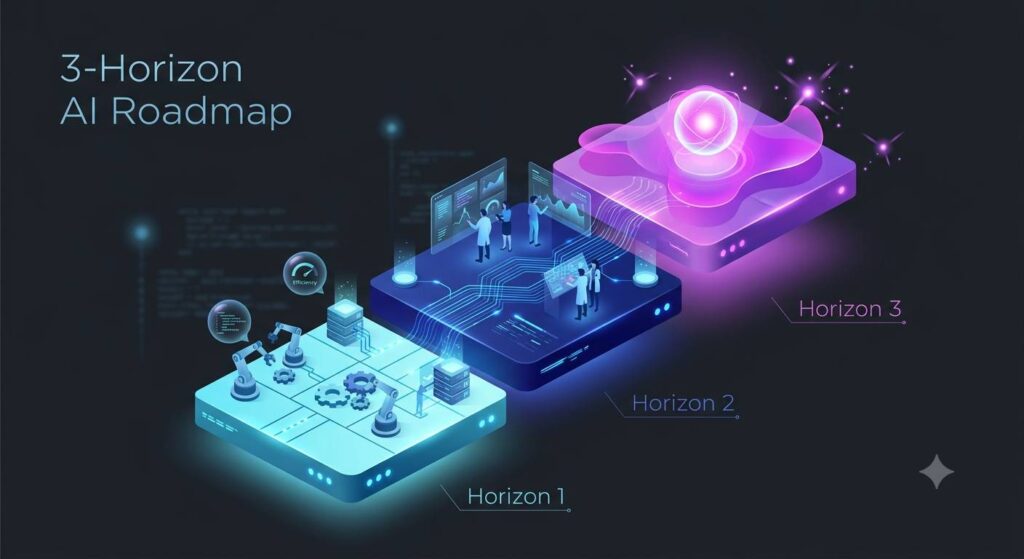
Horizon 1 (0 to 90 days): ship a small, real thing
Your goal is getting one narrow, high-value AI use case into production. Not a demo. Not a Jupyter notebook. A model serving predictions or generating outputs that a business user depends on for actual work.
Select your highest-scoring use case from prioritization. Build with existing data, deploy on current infrastructure (even if imperfect), establish basic monitoring for model performance and business impact.
This matters because it builds organizational muscle memory for shipping AI. Every subsequent initiative benefits from the deployment patterns, security permissions, and stakeholder trust established here. Horizon 1 success makes everything else possible.
Horizon 2 (90 to 180 days): build the platform beneath the projects
Transition from “artisanal AI”, one-off models hand-deployed by data scientists, to repeatable infrastructure. Establish CI/CD pipelines for models, feature stores for consistent data access, monitoring and observability systems, and model versioning and rollback capabilities.
This is where MLOps roadmap investment happens. Without it, Horizon 1 successes become maintenance nightmares that consume engineering resources without delivering additional value.
Cover infrastructure decisions systematically: managed ML platforms versus custom-built systems, container orchestration for model deployment, model registries for version control, and monitoring systems for production model health. These decisions compound, invest time in getting them right.
Horizon 3 (6 to 18 months): scale, govern, and compound
Expand to multiple AI capabilities in production, governed by clear policies, delivering measurable business outcomes. Implement AI governance frameworks aligned with EU AI Act risk categories and NIST AI Risk Management Framework requirements.
Establish cross-functional AI review boards for use case evaluation and risk assessment. Build internal knowledge sharing systems so successful patterns spread across business units.
Set realistic timeline expectations: most enterprises should expect 12-18 months before AI becomes a genuine organizational capability rather than a collection of isolated projects. Plan accordingly.
Stakeholder alignment as a structural phase, not an afterthought
Treat alignment as ongoing work built into each horizon, not a kickoff meeting you complete once.
Define executive sponsorship models clearly: who owns the AI budget, who owns the business outcomes, and how decisions get made when those two roles disagree. Run cross-functional “pre-mortems” at each phase gate to surface concerns before they become blockers.
Communicate AI progress to non-technical leadership without overpromising. Focus on business metrics influenced rather than technical milestones completed. “Customer service response time improved 23%” resonates better than “deployed three new models to production.”
Address the political reality directly: AI projects often threaten existing workflows and job responsibilities. Plan change management explicitly at each phase rather than hoping resistance resolves naturally.
Kill criteria: knowing when to stop
Every AI initiative on your roadmap should have explicit conditions under which it gets abandoned. This conversation happens rarely in enterprise AI planning, but it should happen first.
Define kill criteria upfront: data quality below defined thresholds after 30 days of remediation effort, model accuracy below business-viable levels after two retraining cycles, regulatory analysis revealing unacceptable compliance risk, or infrastructure costs exceeding projected business value.
Kill criteria make it psychologically easier to start ambitious projects because the organization has clear exit ramps. Without them, zombie projects consume resources for months while stakeholders debate whether “just a little more investment” might turn things around.
Document kill criteria in the roadmap itself, review them at each phase gate, and follow through when criteria are met. This discipline separates successful AI programs from endless pilot factories.
Measuring what matters: shipping velocity over milestone theater
Reframe how your organization tracks AI implementation plan progress. Instead of “milestones completed” or “percent of roadmap delivered,” track metrics that matter: models serving production traffic, business decisions automated or augmented, measurable impact on revenue/cost/speed, and cycle time from concept to first production inference.
Avoid vanity metrics like “number of AI experiments run,” “datasets ingested,” or “models trained.” These measure activity, not shipping. Activity without deployment is expensive research, not business value.
Establish a quarterly review template: four to five metrics, each tied to business outcomes, reviewed with executive sponsors. Keep the review focused on what shipped and what blocked shipping, not what got started.
Governance and compliance as roadmap constraints, not add-ons
Regulatory compliance isn’t optional overhead, it’s a structural constraint that shapes what you can build and how quickly you can deploy it. The EU AI Act has been enforceable since 2025 for high-risk AI systems. NIST’s AI Risk Management Framework provides increasingly referenced guidance for US organizations.
Build compliance checkpoints into each horizon: risk classification during use case prioritization (Horizon 1), documentation and audit trail infrastructure during platform development (Horizon 2), and ongoing monitoring and conformity assessment in Horizon 3.
Global enterprises face overlapping regulatory requirements across jurisdictions. Your roadmap must account for the most restrictive compliance requirements early, not retrofit compliance after deployment decisions are locked in.
Keeping the roadmap alive
AI roadmaps degrade faster than traditional technology roadmaps. Model performance drifts as data distributions change. Business priorities shift quarterly. New regulations emerge. Competitive dynamics evolve.
Establish a quarterly review cadence: revisit use case prioritization scores based on deployment learnings, update horizon timelines based on actual velocity, reassess kill criteria based on new information, and incorporate patterns from successful (and failed) initiatives.
Maintain the roadmap as a living document in version control, not a slide deck updated annually. Track changes, document decisions, and make the current version accessible to all stakeholders.
A practical starting point
Start this week: run the Phase Zero readiness audit across your top three AI use case candidates. Score them honestly across data, infrastructure, talent, and regulatory dimensions. Calculate which horizon your organization should start in based on aggregate readiness.
Bring these scores to your next leadership meeting. Present them as a foundation for realistic timeline and investment discussions, not as obstacles to overcome.
The AI roadmap that ships is the one built around constraints, not aspirations. Your constraints aren’t limitations, they’re the design parameters that turn ambitious strategy into deployable systems.
Begin with what you can actually build, deploy, and maintain. Everything else is just expensive slide decks.
Ready to assess your AI infrastructure readiness? AI Cloud’s infrastructure assessment services can accelerate your Phase Zero audit with comprehensive analysis of your data, compute, and deployment capabilities. Contact our enterprise AI team to begin your reality-first roadmap development.
Frequently asked questions
What’s the difference between an AI roadmap and a digital transformation strategy?
An AI roadmap is a specific implementation plan focused on deploying AI capabilities within existing organizational constraints. A digital transformation strategy is broader, encompassing process changes, cultural shifts, and technology adoption across the entire organization.
How long should an enterprise AI roadmap timeline be?
Most successful enterprise AI roadmaps operate on 12-18 month cycles with quarterly review points. Longer timelines lose organizational attention; shorter timelines don’t account for the infrastructure and governance work required for production deployment.
What’s the biggest mistake enterprises make when building AI roadmaps?
Starting with ambitious use cases instead of data readiness. Most roadmap failures trace back to assuming data is available in model-ready form when it requires months of cleaning, labeling, and governance work first.
Should AI governance be a separate workstream or integrated into the roadmap?
Integrate governance checkpoints into each horizon rather than treating compliance as a parallel track. Governance requirements shape what you can build and how quickly you can deploy, they’re design constraints, not afterthoughts.
How do you know if your AI roadmap is working?
Track shipping velocity: models in production serving real business users, business metrics influenced by AI decisions, and cycle time from concept to production deployment. Avoid activity metrics like experiments run or data processed.