IT leaders are walking away from best-of-breed vendor stacks. The coordination tax has gotten bigger than the capability gain. When every tool is “best in its category” but nothing talks to anything else cleanly, your team spends more time managing integrations and contracts than running infrastructure. Vendor consolidation reverses that. Fewer relationships. Fewer seams. One team accountable when something breaks.
This isn’t a finance-team cost-cutting exercise dressed up in IT language. Done right, it’s an infrastructure decision with security, integration, and continuity implications that a spend-analysis spreadsheet won’t surface. That’s the gap in most of what’s written about vendor consolidation today. It treats the decision as a pure savings calculation. It skips the part where you actually have to migrate, integrate, and hand off operational control without breaking anything.
What vendor consolidation actually means for IT, not just procurement
Vendor consolidation means reducing the number of distinct vendors responsible for your infrastructure stack: cloud, network, security, endpoint management, helpdesk. You’re moving down to a smaller set of providers who own more of the stack end to end. The procurement version of this story stops at contract counts and line-item savings. The IT version has to account for what happens to your architecture. Which integrations get retired. Which data has to migrate. Which monitoring and alerting pipelines need to be rebuilt. Who’s accountable for uptime during the transition.
This matters because IT vendor sprawl doesn’t just cost money. It costs visibility. When five vendors each own a slice of your environment, nobody has the full picture during an incident. Consolidation is as much about collapsing that blind spot as it is about the invoice total.
The consolidation risk-adjusted savings score: a framework for deciding if and when to consolidate
Most vendor consolidation guidance, including widely-cited finance-focused playbooks, scores a consolidation move on one axis: how much money it saves. That’s an incomplete picture for an infrastructure decision. The Consolidation Risk-Adjusted Savings Score weighs a proposed consolidation across four dimensions, each scored 1 to 5. You can compare candidate moves against each other instead of chasing the biggest sticker-price savings and walking into an integration mess.
| Dimension | What it measures | 1 (low) | 5 (high) |
|---|---|---|---|
| Savings Magnitude | Realistic cost reduction from consolidating, after transition costs | Under 10% reduction | Over 30% reduction |
| Integration Complexity | How many systems, APIs, and data flows have to be re-pointed | 5+ dependent systems | Fewer than 2 dependent systems |
| Security Exposure Window | How long identity, access, and data sit in a transitional state during cutover | Multi-month parallel run | Single-weekend cutover |
| SLA and Exit Risk | How exposed you are if the new vendor underperforms or you need to exit | Multi-year lock-in, no exit clause | Clear SLAs, defined exit terms |
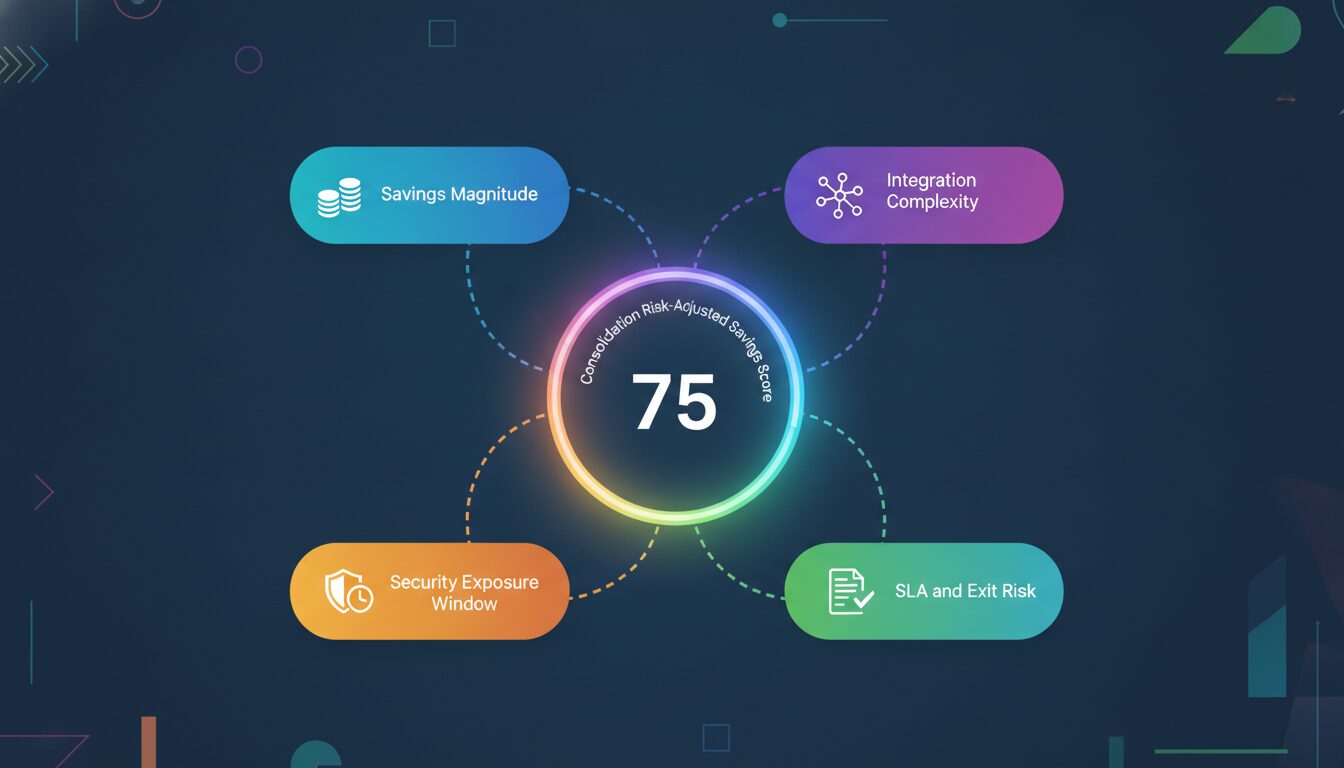
Add the four scores. A consolidation candidate scoring 16 to 20 is a strong near-term move. A score of 10 to 15 means the savings are real, but the transition needs a tighter project plan before you commit a date. Below 10, the integration and security risk likely outweighs the savings. That vendor relationship isn’t ready to consolidate yet, even if the discount looks attractive.
Here’s how that plays out on two real candidate moves we see come up constantly in enterprise environments. Consolidating helpdesk and endpoint management onto one vendor typically scores high. Savings magnitude lands around 4: meaningful cost reduction, modest transition cost. Integration complexity is low at 4, since these systems usually have clean, well-documented APIs. The security exposure window is tight at 4, because device enrollment can be staged without touching core identity systems. SLA and exit risk is moderate at 3. That’s a 15. Ready to move on with a solid project plan, not a deal-breaker on any dimension.
Compare that to consolidating your SOC and identity provider into a single vendor at the same time. Savings magnitude might score a 5 on paper, the biggest discount in the negotiation. But integration complexity drops to 1 or 2, since nearly everything in your environment touches identity. The security exposure window scores a 1, because you’re re-pointing authentication and access policies for the entire org during cutover. SLA and exit risk often lands around 2 if the new provider wants a multi-year commitment before you’ve seen them operate your environment. That totals 9 to 10, below the threshold. The framework doesn’t say don’t do it. It says don’t do it as a single simultaneous event, and don’t sign a long-term commitment before a parallel-run period proves the new provider out.
The real cost of vendor sprawl shows up after the contract is signed
The sticker price of running five infrastructure vendors instead of one rarely shows up as a single line item. It shows up as the SOC analyst who has to check three different dashboards during an incident. It shows up as the help desk ticket that bounces between two vendors because neither will claim ownership. It shows up as the renewal cycle that never lines up, so you’re always mid-negotiation with someone. Organizations that consolidate onto a single accountable infrastructure partner typically see 25 to 35% lower total cost compared to managing the same scope across multiple vendors. That tracks with the broader trend: most CIOs now treat vendor consolidation as a standing priority rather than a one-time cost exercise, once you account for the duplicate tooling, the integration overhead, and the staff time spent coordinating between providers rather than managing the environment itself.
That number holds up because most of the savings isn’t contract-price arbitrage. It’s the elimination of coordination overhead that never appears on an invoice but consumes real engineering and operations time every week.
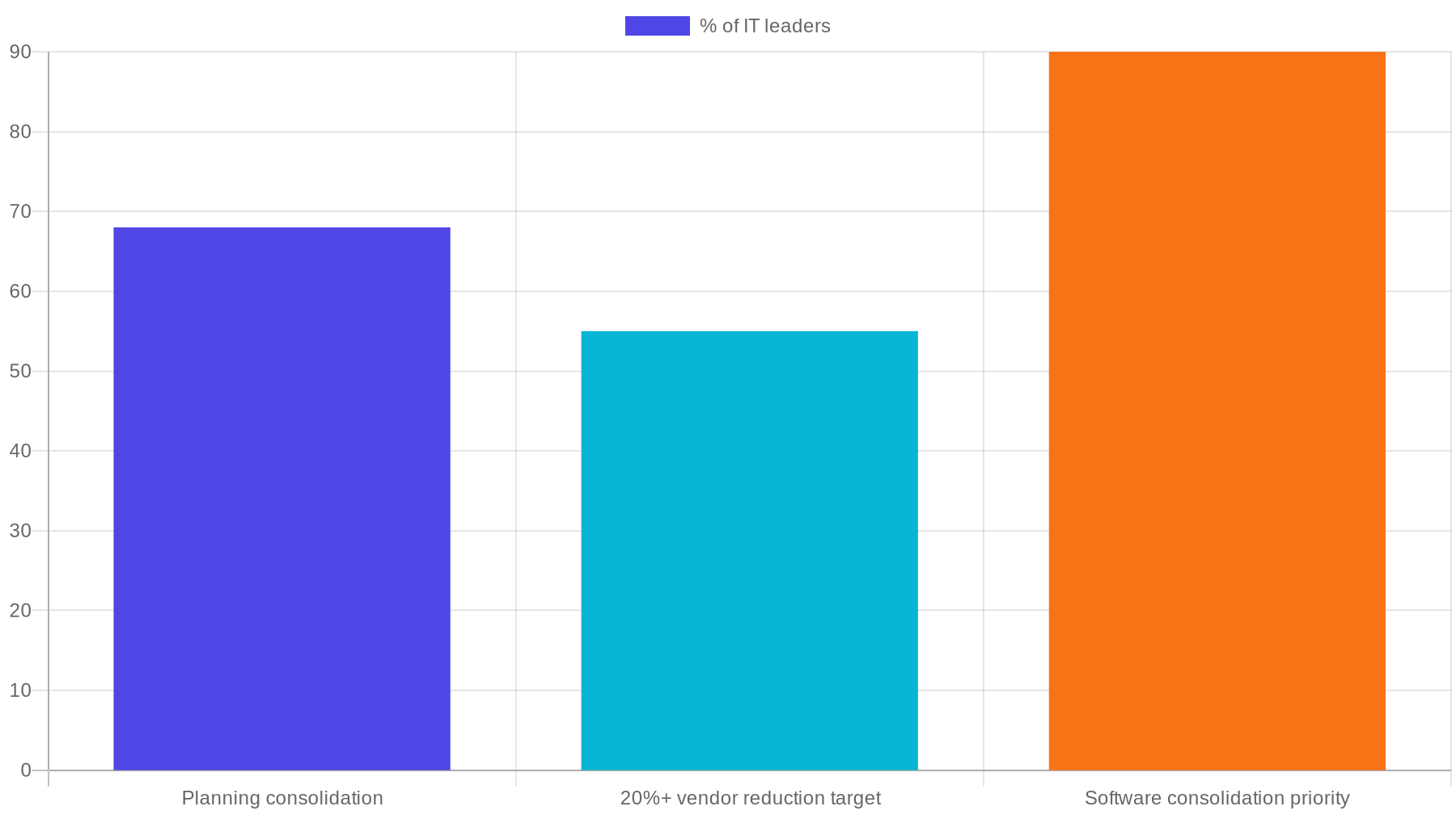
Source: industry survey data on IT vendor consolidation trends, 2026.
What most teams get wrong when consolidating vendors
The most common mistake is treating consolidation as a procurement event instead of a migration project. Teams sign the new contract, then discover three months later that nobody mapped which monitoring alerts, firewall rules, and service accounts depended on the vendor being replaced. The fix isn’t more contract negotiation. It’s treating every consolidation as a real infrastructure cutover with a dependency map, before any vendor gets terminated.
The second mistake is consolidating security and infrastructure vendors at the same time as a single event. Collapsing your SOC vendor and your cloud vendor into one move multiplies the security exposure window from the framework above. You want overlapping but staggered cutovers, not a simultaneous flip of every credential and access policy in your environment.
The third mistake is skipping the exit clause conversation because the new vendor relationship feels like a long-term partnership at signing time. Every consolidated vendor contract should specify a defined transition-out period and data portability terms, even if you have no intention of using them soon. You’re trading vendor diversity for vendor depth. Make sure depth doesn’t become dependency you can’t unwind.
The fourth mistake, and the one that compounds the other three, is consolidating without a disaster recovery re-test. Your existing DR plan almost certainly assumes the old vendor’s failover behavior, backup cadence, and recovery time objectives. A new vendor changes all three, often without anyone explicitly checking. We’ve seen teams discover their RTO doubled only after an actual incident post-consolidation, because the new provider’s backup architecture wasn’t validated against the same recovery assumptions the old runbook was written for. Re-test DR as part of the cutover. Don’t treat it as a follow-up task that gets deprioritized once the migration is declared done.
Step by step: how to audit and consolidate your vendor stack
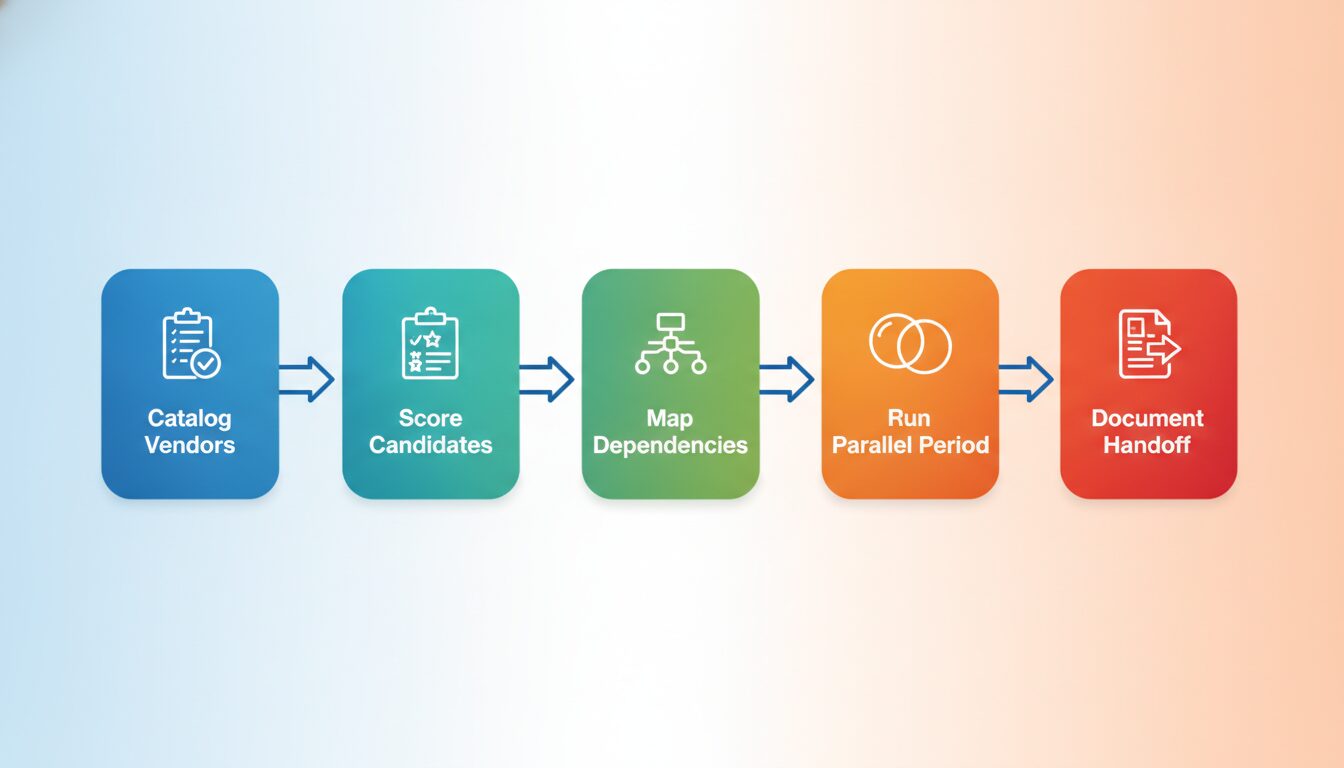
Start by cataloging every active infrastructure vendor and what they actually own. Not what the contract says they own, but what’s running in production today. Most environments have at least one vendor relationship that’s contractually active but functionally redundant with something else already in place.
Score each consolidation candidate using the Consolidation Risk-Adjusted Savings Score above. Rank candidates by score, not by raw savings. A high-savings, high-risk consolidation should wait behind a moderate-savings, low-risk one if your team has limited bandwidth for transition work this quarter. If one of your candidate consolidations involves a cloud provider migration specifically, ground the savings estimate in real numbers rather than a vendor’s quoted discount. A tool like this cloud migration cost calculator accounts for the transition costs that quoted discounts usually leave out.
Map every system dependency for the vendor being replaced before signing anything with the new provider: API integrations, service accounts, monitoring hooks, firewall and network policies, and any automation that assumes that vendor’s tooling is in place. This is the step most teams skip, and it’s the one that turns a planned transition into an unplanned outage.
Run a parallel period where the new vendor is live but the old vendor isn’t fully decommissioned. Scale it to the security exposure window from the framework: shorter for low-complexity moves, longer for anything touching identity or access management. Cut access for the outgoing vendor only after the parallel period confirms the new vendor is handling production load cleanly.
Document the operational handoff explicitly. Who’s on call. What the new escalation path looks like. Where the updated runbooks live. A consolidation that saves money but leaves your team without a clear escalation path during the next incident hasn’t actually reduced risk. It’s relocated it.
If your environment carries compliance obligations such as SOC 2, HIPAA, or PCI, factor the audit cycle into your timing. Consolidating vendors mid-audit-period means re-documenting controls and evidence collection for the new provider while the audit clock is still running. It’s usually cleaner to time a consolidation around your audit cycle rather than through the middle of it. If you’re not sure where your current evidence-collection gaps are, this SOC 2 Type 2 audit preparation checklist is a useful starting point for mapping what a new vendor needs to pick up.
Single vendor vs multi-vendor IT: a side-by-side comparison
| Multi-Vendor | Single Accountable Vendor | |
|---|---|---|
| Incident response | Coordination required across providers before root cause is even confirmed | One team owns the full stack and the timeline |
| Contract management | Staggered renewals, duplicate negotiation cycles | Single renewal cycle, consolidated leverage |
| Security visibility | Fragmented across separate monitoring tools | Centralized monitoring across the full environment |
| Cost | Higher due to duplicate tooling and coordination overhead | Typically 25-35% lower total cost of ownership |
| Vendor leverage | Diluted across many smaller relationships | Concentrated, often improving SLA terms over time |
FAQs
Does vendor consolidation increase security risk?
It can, but only during the transition itself, not as a permanent state. The exposure comes from the cutover window when access and identity sit in a transitional state between vendors. Score that window explicitly using the security exposure dimension above. Stagger consolidations involving identity or access management rather than flipping everything at once.
How long does a vendor consolidation transition typically take?
It depends on integration complexity. A single infrastructure domain, like consolidating endpoint management, often runs 4 to 8 weeks including a parallel-run period. Consolidations touching identity, access management, or core network infrastructure usually need longer, sometimes a full quarter, to keep the security exposure window manageable.
What’s the difference between vendor consolidation and vendor rationalization?
Rationalization is the assessment phase: cataloging vendors, identifying overlap and redundancy. Consolidation is the action that follows: actually reducing the vendor count and migrating the underlying systems. You can rationalize without consolidating, but you shouldn’t consolidate without rationalizing first.
Is vendor consolidation worth it for a multi-site organization?
Often more so than for a single-site company, because the coordination overhead multiplies across locations. Standardizing on one infrastructure partner across multiple sites gives you a single point of visibility and a consistent security posture, instead of reconciling different vendor configurations at every location.
Should we consolidate everything at once, or in phases?
In phases, scored and sequenced using the framework above. Simultaneous consolidation across security, cloud, and network vendors compounds the exposure window and overwhelms your team’s capacity to manage multiple cutovers cleanly. Start with the highest-scoring, lowest-complexity candidate and use it to validate your transition process before tackling higher-complexity moves.
What to do next
Catalog your current vendor stack this week, not after the next contract renewal forces the conversation. Score each vendor relationship against the four dimensions above. Prioritize the highest-scoring, lowest-risk candidate as your first consolidation move rather than the one with the biggest sticker-price savings. Map dependencies before you sign anything with a replacement vendor, and insist on defined exit terms even in a relationship you expect to keep long-term. If you want a second set of eyes on how your current stack scores, Zaplio’s infrastructure services team can walk through a vendor audit with you.