Zero-trust architecture is a security model built on one principle: no user, device, or workload gets implicit access to anything, ever. Every access request goes through explicit authentication and authorization, regardless of where the request originates. That includes traffic from inside your own data center.
If you are planning a rollout, the sequence matters more than the technology you pick. Most teams buy a ZTNA solution, deploy it for remote access, and call it progress. That is one pillar out of five, standing alone. The rest of your network still runs on decades of implicit trust. One misconfigured service account and the attacker who got through your perimeter has a clear path to everything.
This guide covers what zero-trust architecture actually requires, how to assess your current state before buying anything, and how to run a sequenced rollout across a real enterprise environment with legacy systems, fragmented vendors, and a security team that already has too much on its plate.
Zero Trust Is Not a Product. It Is an Architecture Decision.
The zero-trust model was formalized by NIST in Special Publication 800-207, published in 2020. The core idea predates the publication by about a decade. Forrester analyst John Kindervag coined the term around 2010, after observing that perimeter security failed not because the firewalls were bad, but because everything inside the perimeter was trusted by default.
That default trust is the problem. When an attacker compromises a contractor laptop, or a disgruntled employee abuses a shared service account, or a misconfigured API exposes an internal endpoint, the perimeter model has nothing left to offer. The attacker is already inside. They move laterally at will, because your internal systems trusted them without question.
Zero-trust architecture changes the unit of protection. Instead of defending the network edge, you defend each resource individually. Access is granted based on verified identity, device health, and context, not network location. The IBM Cost of a Data Breach Report 2024 found that organizations with mature zero-trust implementations saved an average of $1.76 million per breach compared to those without. The average breach cost for organizations without mature zero trust: $4.88 million.
Those numbers matter for the business case. But before you can have that conversation with your CFO, you need to know what your current environment can actually enforce, and where the gaps are.
The Zero Trust Readiness Inventory (ZTRI): Before You Buy Anything
The Zero Trust Readiness Inventory is a five-pillar self-assessment that maps what your current vendor stack can enforce against what zero-trust architecture requires. It takes one to two days to complete and costs nothing. It tells you which pillars you can strengthen by reconfiguring tools you already own, and which pillars require net-new investment.
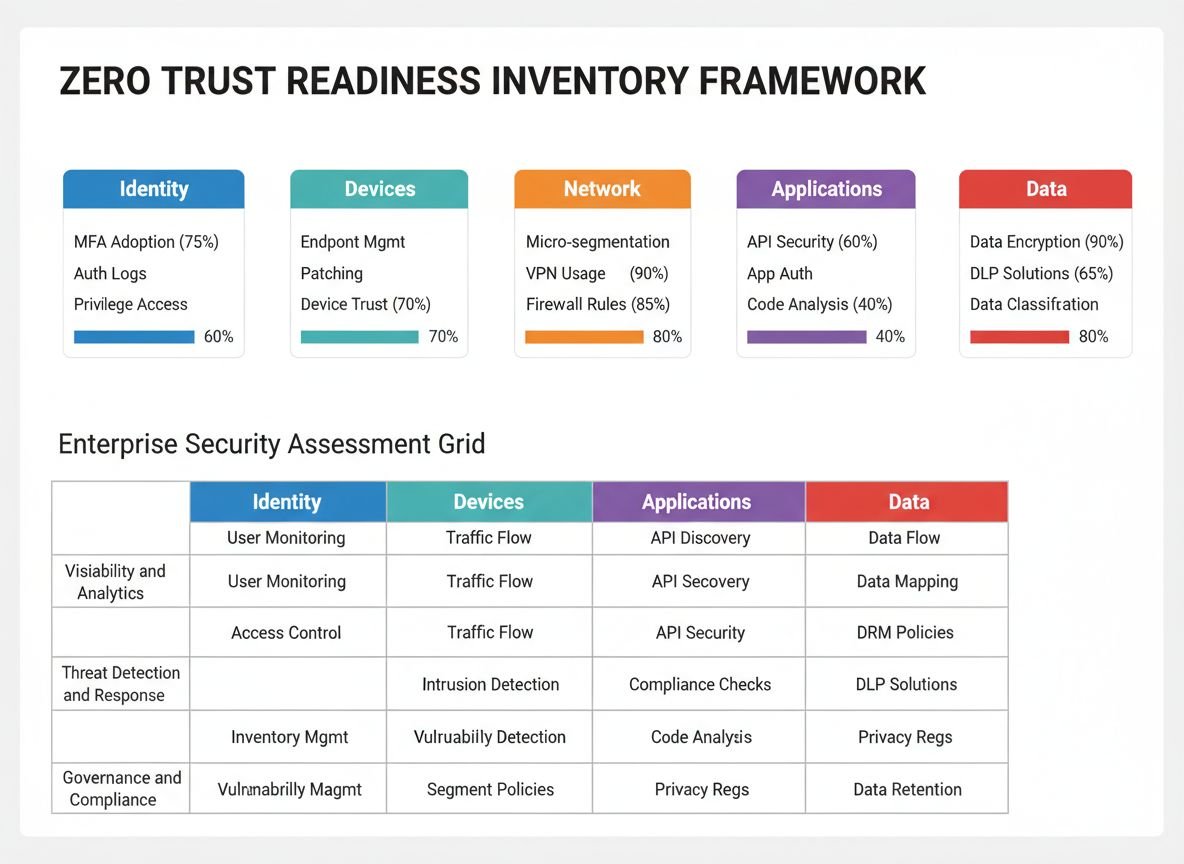
Pillar 1: Identity. Can every user authenticate with MFA? Do you have a centralized identity provider, or do different systems manage their own credentials? Do privileged accounts have stricter policies than standard user accounts? The most common gap here is service accounts: credentials shared across multiple systems, often with excessive permissions, rarely rotated, and not enrolled in MFA because no one designed a process to do it.
Pillar 2: Devices. Can you verify device health before granting access? Do you have MDM or EDR coverage across all endpoints, including contractor and BYOD devices? The typical enterprise has a managed device percentage somewhere between 70 and 85 percent. The remaining 15 to 30 percent are accessing internal resources with no enforcement whatsoever.
Pillar 3: Network. Is your network micro-segmented, or is it flat? Can you restrict lateral movement between segments once an attacker is inside? Most enterprise networks were designed for availability, not segmentation. Flat networks are the default, not the exception.
Pillar 4: Applications and Workloads. Are your applications enforcing their own access controls at the resource level, or do they rely on network placement for security? This pillar is where legacy applications create the most friction. A 15-year-old internal ERP system almost certainly authenticates users via Active Directory without any conditional access policies applied.
Pillar 5: Data. Do you know where your sensitive data is? Is it classified? Are access controls on the data itself, not just on the application that displays it? Most organizations have partial answers to these questions. Mature data-level controls are the last pillar to reach, not the first.
Score each pillar from 1 to 5 based on current enforcement capability. Any pillar scoring 1 or 2 is a gap that will undermine every other investment you make. A ZTNA deployment that sits in front of a flat internal network, with unmanaged devices and no data classification, is security theater. The ZTRI exists to prevent that outcome. If you want a structured ZTRI walkthrough for your environment, Zaplio runs these assessments as a first engagement before any tooling decisions are made.
ZTNA vs. VPN vs. SDP: Picking the Right Access Layer
Once you understand your current state, the access layer decision becomes clearer. Here is how the three main options compare for enterprise deployments:
| Capability | Traditional VPN | Software-Defined Perimeter (SDP) | ZTNA |
|---|---|---|---|
| Trust model | Network-based (once connected, inside) | Identity-based with dynamic perimeter | Identity + device + context, per request |
| Lateral movement risk | High (full network access granted) | Medium (segmented by identity) | Low (application-level access only) |
| Legacy app compatibility | High | Medium (requires agent or proxy) | Variable (depends on ZTNA vendor) |
| User experience | Degraded (latency, disconnects) | Moderate | Better than VPN for cloud apps |
| Typical implementation timeline | Already deployed (replace, not add) | 3 to 6 months | 3 to 9 months for initial rollout |
| Integration complexity | Low | Medium | Medium to high (depends on IdP, EDR) |
| Cloud-native readiness | Low | Medium | High |
The short version: ZTNA is the right direction for most enterprise environments building toward zero trust. The catch is legacy applications. If you have applications that cannot handle modern identity federation or that rely on IP-based access controls, a full ZTNA deployment will require workarounds: identity-aware proxies, application gateways, or a phased migration where legacy apps stay behind the VPN temporarily while newer systems move to ZTNA.
Zscaler’s 2025 ThreatLabz report found that 96% of organizations favor a zero-trust approach, and 65% plan to migrate from VPN to ZTNA within the year. The intent is clear. The execution is where plans collide with reality.
The Six-Phase Rollout: What to Do and in What Order
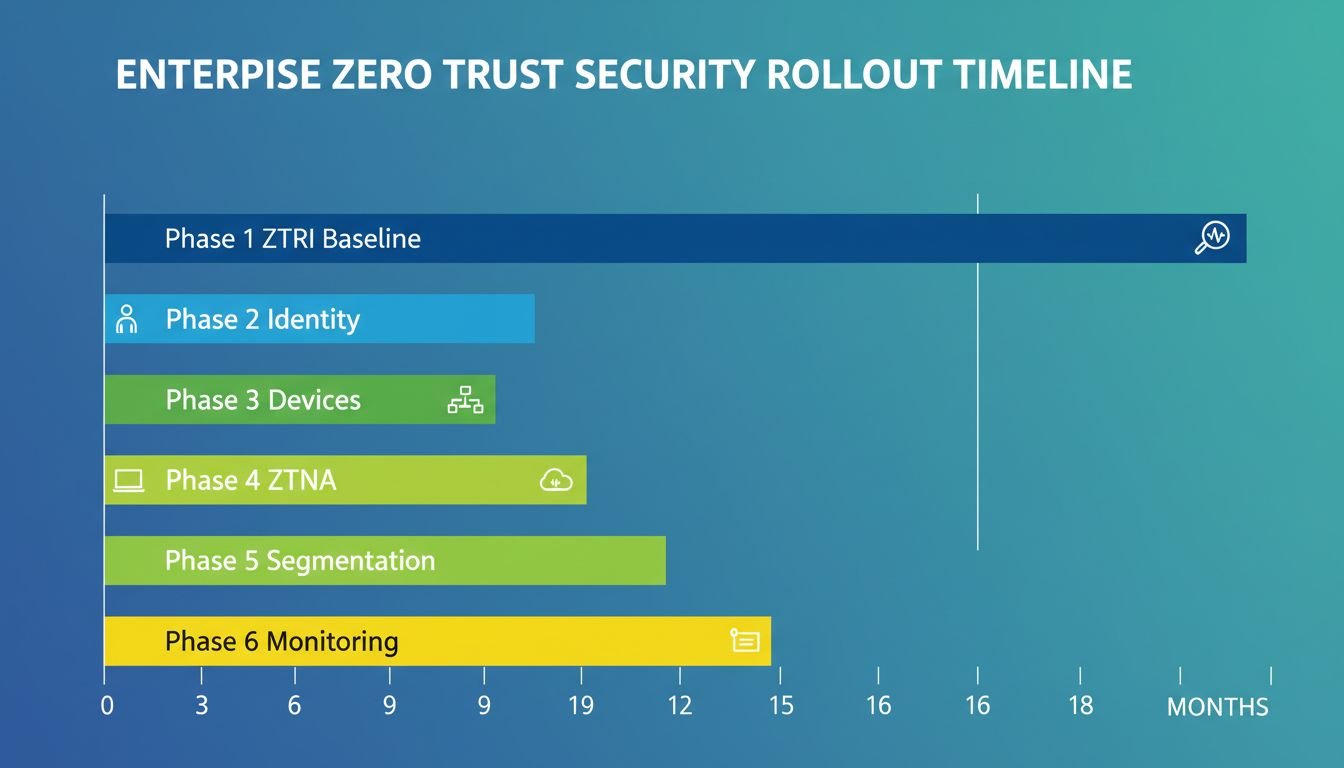
Phase 1 (Months 0 to 2): Run the ZTRI and establish a baseline. Before touching any technology, complete the five-pillar inventory. Document your current MFA coverage, managed device percentage, network segmentation boundaries, and data classification state. This baseline becomes your measurement for progress at the end of every subsequent phase. It also tells your leadership exactly what the gaps are, which makes budget conversations considerably easier.
Phase 2 (Months 1 to 4): Close identity gaps first. Identity is the control plane for everything else. Enforce MFA across all user accounts, starting with privileged and administrative accounts. Audit service accounts, rotate credentials, and apply least-privilege principles. If your organization uses multiple identity providers across different business units or acquired companies, this is the phase where you start consolidating toward a single IdP or establishing federation. This is painful. It is also the highest-value work in the entire rollout.
Phase 3 (Months 3 to 7): Device compliance policies. Deploy MDM or EDR to close the unmanaged device gap. Establish device health as a condition for resource access. A user with valid credentials on a compromised personal laptop should not get the same access as a fully managed corporate device. Block access from non-compliant devices or route them to a restricted network segment where monitoring is tighter.
Phase 4 (Months 5 to 10): Deploy ZTNA for cloud and SaaS access. Start with cloud-hosted applications where ZTNA integration is straightforward. Replace VPN tunnels for those applications with ZTNA. This gives you a measurable win: reduced VPN load, better user experience for cloud app access, and real enforcement of identity plus device checks before access is granted.
Phase 5 (Months 8 to 15): Micro-segmentation and legacy app migration. Begin network micro-segmentation, starting with your highest-value internal segments: anything touching financial data, PII, or production infrastructure. For legacy applications that cannot yet move to ZTNA, apply compensating controls: tighter firewall rules, privileged access workstations for administrative access, and audit logging at the network layer.
Phase 6 (Months 12 to 18): Data classification and continuous monitoring. By this phase, you have addressed the most critical identity and network gaps. Now you can invest in data classification and data-level access controls without them being undermined by ungoverned identities or flat networks. Establish continuous monitoring policies: anomaly detection, behavioral analytics, and automated response playbooks that work within your SOC workflows rather than requiring a separate response process.
Where Most Enterprise Rollouts Break Down
Gartner estimates that only 10% of large enterprises will have mature zero-trust programs by the end of 2026. The technical barriers are real. But in most rollouts that stall, the failures are organizational, not technical.
The most common mistake is starting with the tool instead of the inventory. A team buys a ZTNA platform, deploys it for the 500 users who access cloud applications, and then discovers that the other 3,000 users connect via a legacy VPN to a flat internal network with no device compliance checks. The ZTNA deployment is real. The zero-trust posture is not.
The second mistake is treating zero trust as a one-team project. Network teams, identity teams, endpoint teams, application teams, and security operations all have work to do in a zero-trust rollout. When accountability sits in one team and the others see it as someone else’s priority, phases 3 through 6 stall while the identity team waits for network micro-segmentation that the infrastructure team has not prioritized.
The third mistake is underestimating the legacy application problem. Most enterprise environments have applications that predate modern identity federation. These applications authenticate via NTLM, Kerberos, or proprietary methods. They cannot accept SAML or OIDC tokens. They have no API layer where you can insert an identity-aware proxy. Moving them requires application modernization work, which is a separate workstream with its own timeline and budget. Zero-trust architecture planning needs to account for this explicitly. If it does not, Phase 5 will consume months of unexpected work.
The fourth mistake is conflating compliance with security. Passing a zero-trust maturity audit tells you that your documentation and configurations meet a defined standard at a point in time. It does not tell you that your environment is actually operating as designed under real conditions. Teams that focus on maturity model progression sometimes miss the operational discipline: log review, anomaly response, and the ongoing work of tuning access policies as the environment changes.
One pattern that appears repeatedly across enterprise rollouts: fragmented vendor stacks create enforcement blind spots that no single team sees clearly. When your identity provider, your EDR, your ZTNA platform, and your network monitoring tools come from four different vendors with four different management consoles, the integration work required to enforce a coherent policy is significant. When something breaks, the accountability question becomes complicated fast. Consolidating vendor relationships is not just a cost efficiency play. It is a zero-trust enablement strategy. You can read more about how this shows up in practice in our analysis of cybersecurity risk management for enterprise IT.
Compliance Alignment: What Zero Trust Covers (and What It Doesn’t)
Zero-trust architecture aligns with several major compliance frameworks, but it does not automatically satisfy any of them. Understanding the distinction saves you from compliance surprises late in the rollout.
NIST SP 800-207 is the primary zero-trust reference standard. Implementing its guidance puts you in a strong position for FedRAMP, CMMC, and federal agency mandates under Executive Order 14028. If you are in the federal supply chain, this framework is effectively required reading.
For SOC 2 Type 2, zero trust directly supports several Trust Service Criteria around logical access, monitoring, and change management. It does not replace the evidence-gathering and audit preparation work. A SOC 2 Type 2 audit preparation checklist will help you identify which controls your zero-trust implementation can serve as evidence for, and which controls require separate documentation.
For organizations managing cybersecurity risk programs under ISO 27001 or HIPAA, zero trust strengthens access control and audit trail requirements significantly. But HIPAA requires specific administrative and physical safeguard documentation that goes beyond what an access architecture can provide. The architecture reduces your risk surface. The compliance program provides the documentation that proves it.
The key framing for your CISO or legal team: zero-trust architecture reduces the attack surface and demonstrates due diligence on access controls. It does not replace compliance program management. Those are two different workstreams, and the teams running each one need to coordinate on shared evidence so you are not duplicating audit preparation effort.
Frequently Asked Questions
How long does a zero-trust rollout take for a mid-size enterprise?
For an organization with 1,000 to 5,000 users, a realistic timeline for the first four phases is 9 to 12 months with dedicated resources. Full maturity across all five pillars, including data classification and continuous monitoring, typically takes 18 to 24 months. Organizations that try to compress this timeline by skipping the identity consolidation work in Phase 2 consistently experience failures in later phases.
Do we need to replace our VPN entirely, or can we run both?
Most organizations run VPN and ZTNA in parallel for 12 to 18 months during the transition. VPN continues to handle legacy application access that cannot yet move to ZTNA. The migration is application-by-application, not a single cutover. Plan for parallel operation costs during this period. The VPN footprint shrinks as applications migrate, but it rarely reaches zero quickly unless the organization also modernizes its legacy application portfolio in parallel.
What is the realistic budget for a zero-trust rollout?
Identity consolidation and MFA enforcement (Phase 2) is often the lowest-cost phase because it typically involves reconfiguring tools you already own. Device management (Phase 3) adds MDM or EDR licensing where coverage is incomplete. ZTNA licensing (Phase 4) is a net-new cost that partially offsets VPN infrastructure costs. Network micro-segmentation (Phase 5) carries the highest implementation cost in labor, particularly if it requires firewall policy rewrites across a complex on-premises environment. Scoping these phases separately produces accurate estimates rather than a single large number that derails budget conversations before they begin.
Can we implement zero trust without replacing our existing security tools?
Often, yes, for the first two phases. Most organizations already own tools that can enforce MFA, conditional access, and device compliance. They have not configured them to do so consistently. The ZTRI exercise regularly reveals that 40 to 60 percent of Phase 2 work involves enabling features that are already licensed. Net-new tool investment becomes unavoidable in Phases 3 through 5, but front-loading configuration work before purchasing keeps costs lower in the early phases.
How does zero trust interact with our existing SOC workflows?
Zero-trust architecture generates significantly more authentication and authorization event logs than a perimeter model. Your SOC needs to be ready for that volume, and your SIEM needs tuning to distinguish anomalous access events from noise. Plan for elevated alert volume immediately after each deployment phase. Building response playbooks for the new alert types before each phase goes live reduces analyst fatigue and prevents the most common failure mode: alert suppression by overwhelmed SOC teams. For more on building SOC resilience alongside a zero-trust rollout, see what cyber resilience means for enterprise IT teams.
What is the difference between ZTNA and SASE?
ZTNA is a specific access control technology. SASE (Secure Access Service Edge) is an architectural framework that combines ZTNA with SD-WAN, cloud firewall, and other security services, delivered as a unified cloud service. ZTNA can be deployed independently of SASE. SASE includes ZTNA as one of its components. For most enterprise environments, evaluating SASE makes sense during Phase 4 planning, particularly if you are also managing network transformation or cloud migration work at the same time.
What To Do Next
If you are at the beginning of a zero-trust initiative, run the Zero Trust Readiness Inventory before any vendor conversations. Your ZTRI scores will tell you which pillar deserves your first dollar, and they will prevent you from deploying a ZTNA solution on top of an identity estate that cannot support it. The inventory takes one to two days and costs nothing. Every dollar spent on ZTNA before that work is done is partially wasted.
If you are mid-rollout and stalling, check Phase 2 first. In most stalled rollouts, the identity consolidation work is incomplete. Service accounts are still ungoverned. MFA is enforced for some user populations but not others. The downstream phases cannot reach full effectiveness until the identity foundation is solid.
If you are managing a fragmented vendor environment, the coordination overhead across identity, endpoint, network, and monitoring teams is the biggest risk to your timeline. That coordination needs an accountable owner. Assign it explicitly, give that person cross-team authority over zero-trust decisions, and review progress monthly against your ZTRI baseline scores.
The teams that successfully complete zero-trust rollouts are not the ones with the best technology selection. They are the ones that started with an honest inventory, sequenced their work by risk, and kept organizational accountability clear across every phase.
If your environment includes fragmented IT vendors and you need a single point of accountability for your zero-trust rollout, Zaplio’s cybersecurity services bring together identity, endpoint, network, and security operations under one accountable partner, so your rollout moves at the pace your risk profile requires rather than at the pace of your slowest vendor relationship.